Lemontree Foods Continuity Case Study
How Norus Continuity gave Lemontree Foods a fractional technical team to maintain, support, and improve the platform its users, partners, and staff depend on
Client
Lemontree Foods
Sector
Nonprofit + Food Access
Engagement
Norus Continuity
The challenge
Lemontree Foods operates a platform that connects people to food resources and community services. It supports users, partner workflows, messaging, authentication, and scheduling.
When something breaks, the impact is not limited to the technology. A partner may be unable to coordinate support, or someone looking for food may be unable to access the information they need.
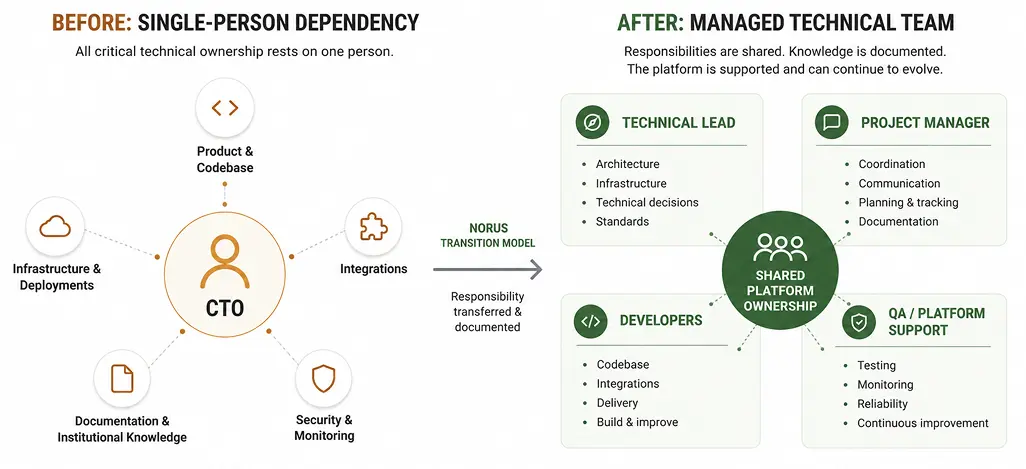
Like many lean, mission-driven organizations, Lemontree managed its platform with a single technical leader. That model can be efficient, but it creates significant risk when that person transitions out of the organization.
When Lemontree’s CTO began planning their departure, leadership acted early. Rather than waiting for a gap to emerge, the organization began addressing the questions that come with any major technical transition:
Lemontree did not want a vendor waiting for individual support tickets. It needed continuity: a team that could absorb technical context directly from the outgoing CTO, respond to urgent needs, evaluate the platform’s underlying condition, and establish a dependable operating rhythm before the transition was complete.
What Norus did
Norus stepped in as Lemontree’s fractional technical team through Norus Continuity, our support model for organizations that depend on live platforms but do not have a full internal engineering team.
The engagement began with a structured technical handover.
Norus worked directly with Lemontree’s outgoing CTO to transfer knowledge of the codebase, infrastructure, deployment processes, integrations, existing documentation, and known technical risks. That handover gave the Norus team the context needed to assume responsibility for the platform without starting from scratch.
A technical audit of the platform
- As part of the transition, Norus also conducted a technical audit of the platform. The audit examined the platform’s architecture, infrastructure, deployment practices, integrations, background processes, database reliability, and areas of accumulated technical debt.
- The team used those findings to distinguish between immediate operational issues and deeper structural risks. Urgent items were added to a prioritized backlog for resolution, while longer-term recommendations were documented for future stabilization and improvement.
A Platform Recommendations roadmap
- At the end of the first 30 days, Norus delivered a Platform Recommendations document that translated the audit findings into a practical roadmap. The roadmap identified opportunities to strengthen the platform’s technical infrastructure, improve reliability, reduce operational risk, and sequence future investments based on urgency and impact.
- This gave Lemontree more than a list of technical observations. It gave leadership a clear plan for improving the platform over time.
Responding to a live platform risk
The transition was tested almost immediately.
During the first month, an external messaging provider changed its requirements, affecting one of Lemontree’s core communication channels. The workflow allowed users to connect with food resources and was critical to the platform’s day-to-day operation.
Norus assessed the impact, scoped the required changes, and implemented the updates before the workflow was disrupted.
The team also addressed related messaging and compliance needs, including sender language, opt-in routing, policy-page access, and friction in the internal workflows Lemontree’s staff used to manage the platform.
The platform remained operational throughout the transition, including during a third-party change that could have interrupted a critical communication channel.
Establishing a sustainable support model
The engagement was not limited to resolving immediate issues.
Norus established an ongoing maintenance and support process built around:
- a managed and prioritized backlog;
- sprint planning;
- weekly check-ins;
- plain-English progress reporting;
- technical risk identification;
- a formal Platform Recommendations document; and
- a stabilization roadmap.
Lemontree determines the organizational priorities. Norus provides the technical context, identifies dependencies and risks, recommends an appropriate sequence, and completes the work.
A project manager leads communication and coordination. Technical leadership guides architecture and platform decisions. Developers investigate, resolve, and maintain the system.
Instead of replacing one technical leader with one external developer, Lemontree transferred responsibility for the platform to a managed technical team with both the operational capacity to maintain it and the strategic context to improve it.
30-DAY HANDOVER TIMELINE
A structured transition to continuity.
1. KNOWLEDGE TRANSFER
Deep handover with the outgoing CTO.
Codebase
Infrastructure
Deployments
Integrations
Documentation
Known risks
2. TECHNICAL AUDIT
Assess the platform end-to-end.
Architecture
Infrastructure
Integrations
Background processes
Database reliability
Technical debt
3. RISK PRIORITIZATION
Identify and prioritize what matters most.
Operational issues
Structural risks
Urgency & impact
Dependencies
4. IMMEDIATE REMEDIATION
Address urgent issues and reduce risk.
High-priority fixes
Provider changes
Compliance needs
Staff workflows
5. PLATFORM ROADMAP
Translate findings into a practical plan.
Recommendations
Sequencing
Investment guidance
Stabilization roadmap
6. ONGOING SUPPORT
Enter the steady state of delivery.
Backlog & sprints
Weekly check-ins
Progress reports
Risk monitoring
WEEKLY & SPRINT RHYTHM
Predictable cadence. Clear communication. Continuous progress.
1. BACKLOG GROOMING
(WEEKLY)
Review, refine, and prioritize the backlog.
New requests
Triage & clarify
Estimate
Prioritize
2. SPRINT PLANNING
(EVERY SPRINT)
Plan the work for maximum impact.
Select top items
Define scope
Confirm effort
Set sprint goal
3. WEEKLY CHECK-IN
(WEEKLY)
Sync on progress and remove blockers.
New requests
Triage & clarify
Estimate
Prioritize
4. PROGRESS REPORT
(WEEKLY)
Plain-English update for leadership.
Completed work
Upcoming work
Risks & dependencies
Decisions needed
The results
FIRST 30 DAYS: RESULTS THAT MATTER
0
Platform disruptions
Users and partners experienced continuous service.
6
High-priority backlog items completed
Critical work delivered and risk reduced.
5
Platform issues resolved
Bugs, defects, and operational issues addressed.
5
Structural improvement areas identified
Key opportunities to strengthen reliability and reduce risk.
The recommendations addressed areas including:
Stronger email delivery infrastructure
Background-task monitoring
Improved database connection resilience
Technical-debt cleanup
The recommendations were not presented as an undifferentiated list of technical concerns. Norus organized them into a roadmap based on urgency, complexity, operational impact, and the level of risk each issue presented to the platform.
This gave Lemontree a practical basis for deciding what to address immediately, what to schedule into upcoming sprints, and where future investment would have the greatest impact on infrastructure and stability.
Remaining items were assessed and prioritized rather than left unmanaged, giving every open issue a clear path forward.
The larger impact
A smooth transition by design
Because Lemontree planned ahead, technical knowledge was transferred rather than lost. Responsibility for the platform moved from one individual to a named team without creating an ownership gap.
A roadmap for long-term stability
Lemontree now has more than a list of fixes. It has a structured backlog, an ongoing maintenance process, a technical team with platform context, and a documented roadmap for strengthening the platform’s infrastructure and reducing future risk.
Clear visibility for leadership
Lemontree’s leadership can now see what has been resolved, what remains open, where technical time is being used, and which risks require attention.
The technical audit and Platform Recommendations document also gave leadership a clearer understanding of the platform’s underlying condition and the investments needed to improve it.
Continuous service for users and partners
The platform remained operational throughout the handover. The affected messaging workflow continued functioning even as external provider requirements changed.
Users and partners were able to continue relying on the platform while the technical transition happened behind the scenes.
Why this matters
Many mission-driven organizations depend on critical platforms that are understood and maintained by one technical leader. That model works until the person leaves, a major integration changes, or an urgent issue emerges without anyone clearly responsible for resolving it.
Lemontree’s experience shows what the alternative can look like: plan the handover early, transfer technical knowledge deliberately, assess the platform’s underlying condition, and put a team in place before the gap opens.
That is what Norus Continuity is built to provide.
Let's talk
Norus Technologies helps mission-driven organizations keep critical platforms stable, supported, and moving forward.
Do you have a live platform your organization depends on, but no full internal technical team to maintain it?